Menu
Send an enquiry

Control systems for machines and processes.

PLC programming, HMI/SCADA visualisation, robot programming, CAD modelling and technical documentation. From brief to site acceptance test.

Who is behind ZOME and how we work →

For electrical contractors, panel builders and plant operators.

Mechatronic: mechanics, electrics and code designed together.

From the brief to the on-site test

This is how the malting-plant project ran: seven steps from the site survey to operator training.

Steeping vessel, germination box and control cabinet with operator panel. Cables run to the temperature (TT), level (LT) and humidity (MT) sensors.TTLTTTMT
  1. Analysis

    site survey, interviews with the process technologist

  2. Specification

    sequences, signals and alarms

  3. Program

    PLC and screens, simulation

  4. FAT

    test with shortened timers

  5. Commissioning

    every signal from sensor to screen

  6. SAT

    trial batch with grain

  7. Handover

    operator training and documentation

The two projects below show in depth how we work. They are not the limit of what we do.

Ammonia plant-room automation

Food plant. Central refrigeration plant room. Control logic design, program, failure analysis and on-site testing.

Automatic compressor control for a plant room with only occasional operator attendance, including machines standing in for each other when one fails.

  • 3.2MWplant cooling demand
  • 4compressors: three reciprocating, one screw
  • 3suction levels: −8, −4 and +3 °C
  • 6consumer circuits, each with its own pump
  • 9control-logic states (state machine)
  • 28failure modes in the FMEA
  • 5conditions in series; without them no machine runs

State machine: 9 states

  1. S0Init / Reset
    • to S1
  2. S1Standby
    • to S2
    • to S3
  3. S2Active −8 °C circuit
    • to S5
  4. S3Standalone
  5. S4Capacity boost
    • to S2
    • to S6
  6. S5Cross-connection
    • to S4
  7. S6COP optimisation
    • to S4
    • to S2
    • to S7
  8. S7Controlled shutdown
    • to S1
  9. S8Emergency / Fault
    • to S0

Only the main transitions are shown. One path through the source diagram is highlighted: from initialisation through capacity boost to controlled shutdown and back to standby. An alarm leads from any state to S8.

Suction levels back each other up

If a machine fails, one compressor also serves a second suction level.

The ammonia plant room as a schematic: four compressors, three piston and one screw, three suction levels at −8, −4 and +3 °C, and six consumer circuits, each with its own pump. The control system is cabled to the compressors’ control units and to the circuit pumps.−8 °C−4 °C+3 °C
Orange: the control system and its signals to the compressors’ control units and the circuit pumps.

Full case study: Ammonia plant-room automation

HMI

More in the case studies.

  • 196 signals
  • 8 screens, 3 access levels
  • 30 alarms in two classes, each with a trigger condition and a system response
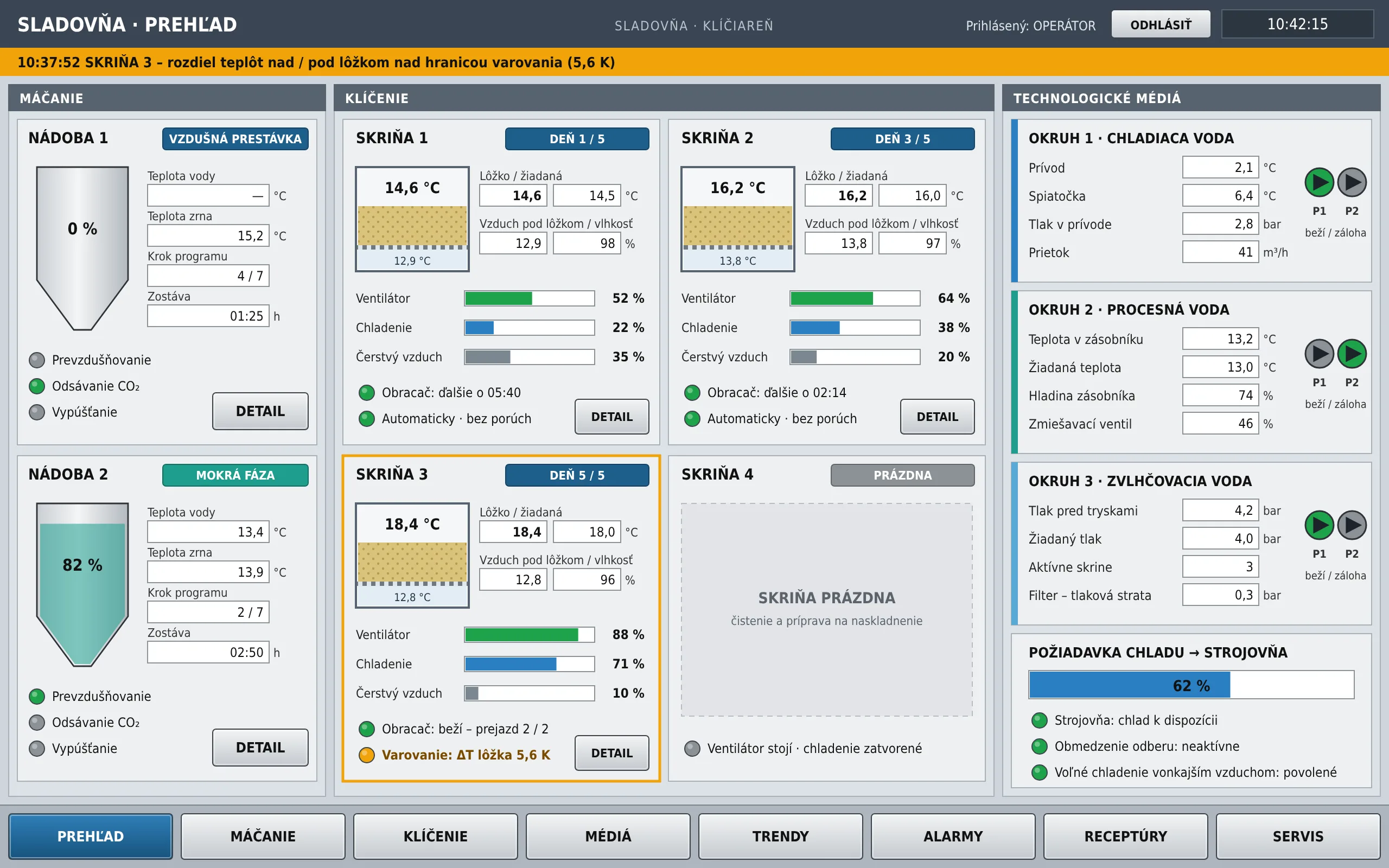
  • Overview screen of the malting plant: two steeping vessels, four germination boxes and the utility circuits.

    Each warning is written next to the equipment it concerns.

    Overview. Vessels show the program step and the remaining time. Boxes show the batch day, bed temperature against setpoint, and fan and cooling load. The total cooling demand for the plant room is on the right.
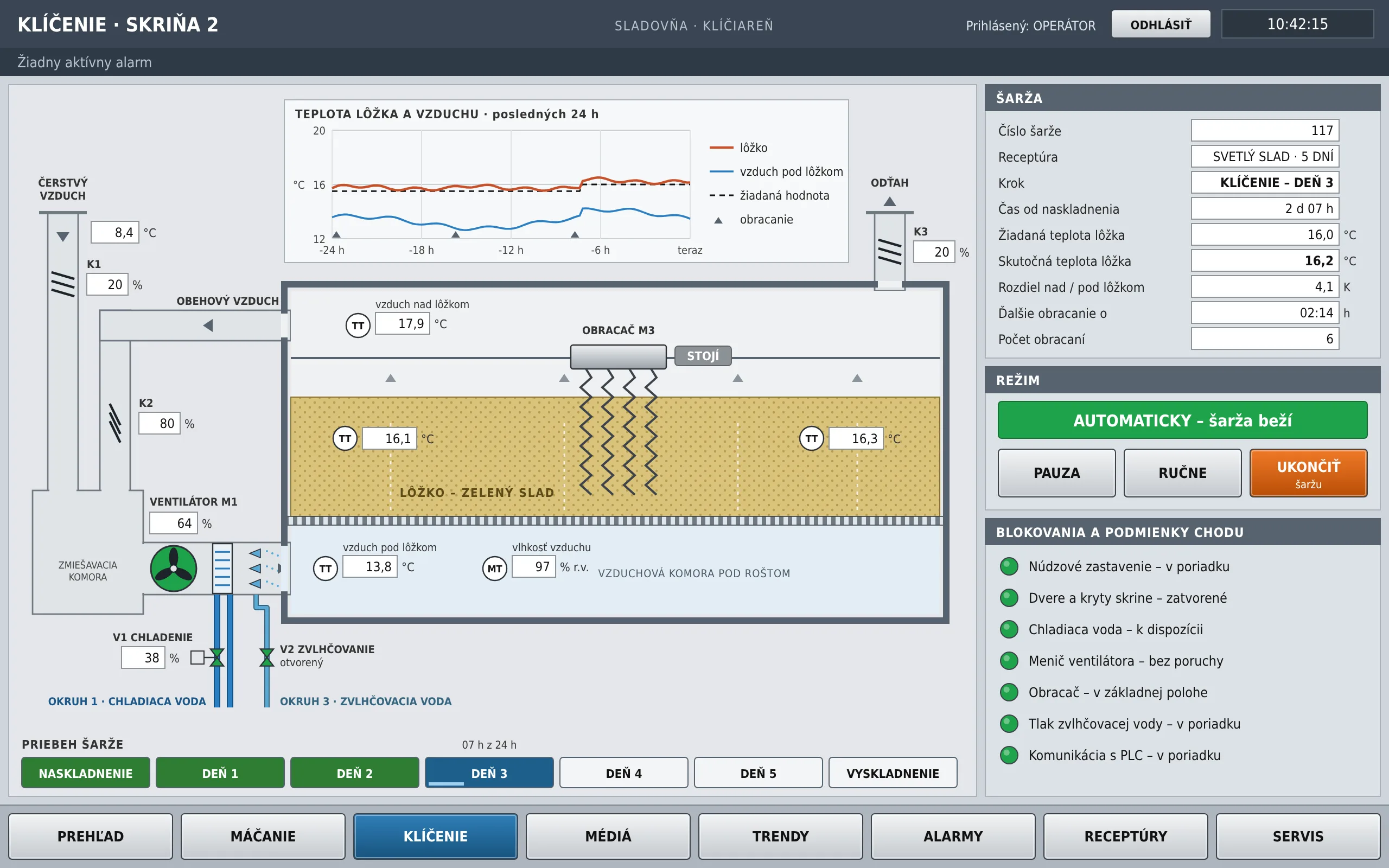
  • Germination box screen: air handling, the bed, a 24-hour trend, batch data and run conditions.

    Run conditions listed one by one, so the operator sees at once which one is missing.

    Germination. A germination box with its air handling, batch progress and run conditions.
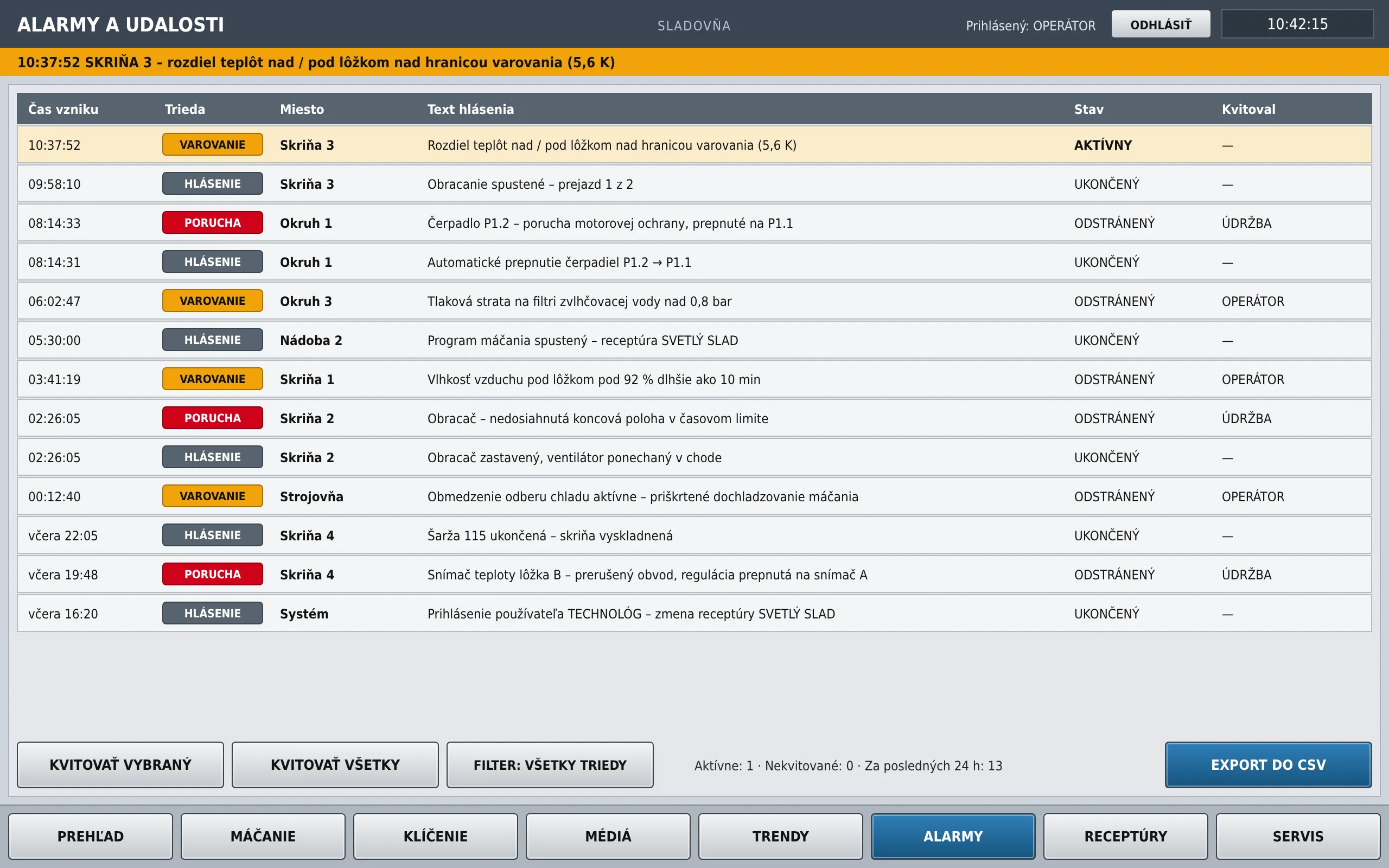
  • Alarm and event screen: time of occurrence, class, location, message text and status.

    Every alarm has a trigger condition and a system response.

    Alarms. Alarms and events with time of occurrence, class, location and status.

The screens are redrawn and in Slovak; values are illustrative.

Full case study: Malting plant control

What we do

Ammonia plant-room control

Control systems for the entire NH₃ refrigeration circuit — from the compressors to every connected plant-room system. We don't reuse off-the-shelf logic: for each plant we find the best solution and build the system around it. We implement self-evaluating logic that decides how machines are deployed, and link every device into one coordinated system run by the PLC program. Safety interlocks follow EN 378-3.

Tools and methods: S7-1200, TIA Portal, state machine, FMEA, EN 378-3

Process control

Recipe-driven batch programs, cascade control, controlled draw of utilities and cooling, S7-1500 / ET 200SP / PROFINET architecture.

Tools and methods: S7-1500, ET 200SP, PROFINET

HMI

WinCC screens and SIMATIC HMI panels.

Tools and methods: WinCC, SIMATIC HMI

Testing and commissioning

Simulation, FAT with shortened timers, every signal checked from sensor to screen, SAT with a test record, operator training, documentation.

Tools and methods: FAT, commissioning, SAT with test record

Beyond PLC

ABB and KUKA robot programming, SolidWorks design, P&ID drawings.

Tools and methods: ABB, KUKA, SolidWorks, P&ID

We also take over existing TIA Portal projects, then optimise and debug them.

Where our methods apply

  • Food and beverage
  • Refrigeration and energy
  • Machine building and production lines (conveyors, handling)
  • Automotive
  • Agriculture and agri-processing

What ZOME stands for

Zero-Defect
every sequence described and tested before it runs
Optimized
tuned to the real process, not a template
Mechatronic
mechanics, electrics and code designed together
Engineering
described, simulated and tested before it reaches site

Let’s start with one clearly scoped package.

We work as a subcontractor on a clearly defined scope: you get a finished, documented package, not billed hours.

Send an enquiry

How we deliver

  1. Fixed scope. One package with a defined output and a fixed price, not billed hours.
  2. Description first. You approve the sequences, signals and alarms before the program is written.
  3. Tested before installation. The program goes through simulation and a test to a written procedure before it goes to site.
  4. Readable handover. Commented program, signal list and functional description. You can change it without us.

Scheduling. We commission and test at weekends and during shutdowns too – exactly when your own people are hardest to find.

How it works

  1. First contact – a few sentences about what you need solved.
  2. We agree terms and sign an NDA.
  3. Only then do we exchange technical documents and prepare an offer for one clearly scoped package.

Ing. Vladyslav Pleshyvtsev
Automation Engineer

+421 951 769 634
info@zomecontrols.sk

Partners

Reference contacts are available on request.